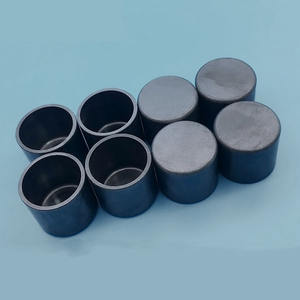
Professional industry ceramic supplier, silicon nitride, silicon carbide, aluminum nitride and any other kinds of ceramics.

The assertion that Boron Nitride (BN) and Aluminum Nitride (AlN) do not possess inherently fixed material properties. They depend on the complex interactions between thermal, electrical, mechanical, and chemical factors within a specific operating environment.
1. Thermal Performance Under Fire: Moving beyond a singular thermal conductivity figure, the critical inquiry is about stability under duress. How does the material’s heat-transfer capability endure when subjected to violent temperature swings, the mechanical flexing of a chip under power cycles, or an unpredictably shifting operational atmosphere? The material must act not just as a conduit but as a stable one, ensuring consistent thermal resistance from the die junction to the heat sink throughout the product’s life.
2. Electrical Integrity That Lasts: This is about being a steadfast insulator over a product’s entire lifespan. Can it maintain sky-high resistivity and breakdown voltage for decades? And can it do so without letting leakage currents creep in or allowing electrochemical migration to slowly damage circuits?
3. Mechanical and Structural Grit: Your thermal solution cannot be the weakest link. It must withstand thermal shocks and expand in harmony with the silicon chip and metal leads it connects to — this is the core of CTE matching. Furthermore, it must resist the gradual threats of deformation, peeling, or cracking under sustained long-term stress.
4. Chemical and Environmental Toughness: Semiconductors operate in the real world, which is inherently corrosive. A reliable material demonstrates inertness. It must not degrade through oxidation at high temperatures, react with environmental moisture (hydrolysis), or inadvertently set up galvanic corrosion cells at its interfaces with solders, bond wires, or encapsulation polymers. This passive durability is often the unsung hero of long-term reliability.

Advantages of Aluminum Nitride (AlN)
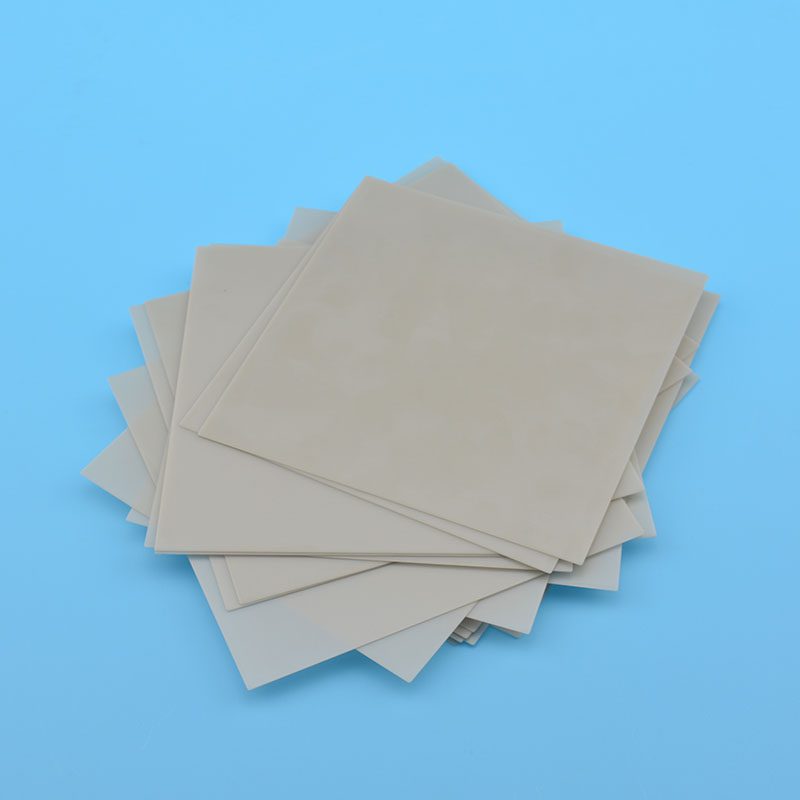
Thermal: AlN provides outstanding, directionally uniform thermal conductivity (typically ranging from 140 to 180 W/mK for premium grades). Its Performance remains stable even at elevated temperatures up to approximately 300°C.
Electrical: It is a superb electrical insulator with a high dielectric strength (~14-17 kV/mm) and low dielectric loss, making it exceptionally reliable for high-voltage applications like power modules and RF devices.
Mechanical: AlN boasts high flexural strength (300-400 MPa) and a hardness comparable to alumina. Crucially, its CTE (∼4.5 x 10⁻⁶/K) is very close to that of silicon (∼3.5 x 10⁻⁶/K), minimizing thermomechanical stress in direct-bonded silicon dies, a key reliability advantage.
Chemical: It forms a passive, protective oxide layer (Al₂O₃) upon exposure to air, which slows further oxidation. It exhibits good resistance to most molten salts and metals.、
Disadvantages of AIN: AlN’s development was initially driven by the search for a non-toxic replacement for beryllium oxide (BeO). Its primary vulnerability emerged as moisture sensitivity.Sintered aluminum nitride (AlN), when exposed to prolonged high-temperature and high-humidity environments (e.g., 85°C, 85% relative humidity), is prone to what is often referred to as “moisture sensitivity” or hydrothermal degradation. When this inherent weakness manifests, both its thermal conductivity and mechanical strength tend to deteriorate. That’s why, historically, when using it in humid regions or similar conditions, robust sealing or encapsulation protection has been essential—essentially, it must be properly “packaged” for reliable application.Furthermore, its high hardness, while beneficial for strength, can be a drawback where conformability to rough surfaces or ease of post-sintering machining is required.
Advantages of Boron Nitride (BN)
Thermal: While its in-plane thermal conductivity can be very high (up to 400 W/mK in oriented pyrolytic forms), it is highly anisotropic. Through-plane conductivity is significantly lower (∼2-30 W/mK depending on form).
Electrical & Dielectric: BN possesses exceptional dielectric strength (∼35-40 kV/mm, superior to AlN), ultra-high volume resistivity, and a low dielectric constant that is stable across frequency and temperature. This makes it supremely reliable for preventing arc tracking in high-frequency, high-voltage environments.
Mechanical: BN is soft, lubricious, and easily machinable. Its reliability feature is its ability to act as a compliant, stress-absorbing layer. And its compressibility can accommodate mismatches, preventing solder joint fatigue or chip cracking.
Chemical: BN is one of the most chemically inert materials known. It is unaffected by most acids, molten metals (like aluminum), and solvents. It is also highly hydrophobic, making it utterly immune to moisture-related degradation—a clear reliability advantage over AlN in harsh environments.
Disadvantages of BN
Its improper orientation leads to thermal failure. Its softness precludes its use as a load-bearing structural substrate. The primary modern challenge lies in its use as a filler in polymer-based Thermal Interface Materials (TIMs). Achieving a high filler loading for optimal conductivity, while simultaneously maintaining the low viscosity needed for application and the rheological stability to resist “pump-out” during thermal cycling, remains a significant, unresolved processing hurdle that directly impacts long-term interface stability.

Conclusion
Choose Aluminum Nitride (AlN) for reliability when you require a rigid, structural substrate for direct bonding (DBC or AMB), especially with silicon or SiC dies. Its reliable performance in high-power IGBT modules, automotive power electronics, and high-brightness LED packages comes down to two key things: excellent CTE matching and uniform thermal conductivity in all directions. These applications demand toughness first and foremost, plus the ability to spread heat quickly and evenly in three dimensions. Of course, when using it, proper moisture protection is absolutely essential—that’s the top priority for ensuring long-term reliability.On the other hand, if your biggest headache is preventing high-voltage breakdown or leakage currents, then Boron Nitride (BN) is your go-to material. Nothing beats it for high-voltage insulators, arc barriers, or RF windows. Made into a soft, compliant thermal pad or blended into thermal grease, it’s especially good at filling microscopic gaps and absorbing stress from thermal expansion and contraction. That’s why you’ll find it in everything from CPU/GPU cooling and aerospace electronics to applications involving molten metal contact. What’s even more remarkable is its naturally inert, almost non-reactive nature. In damp or corrosive environments where other ceramics would fail, BN remains completely unaffected—it’s truly irreplaceable.
Future Trajectory: Hybrids and Engineered Solutions
Honestly speaking, the current drive for ultimate reliability has moved beyond the simplistic “either-or” selection mindset. The clear trend for the future lies in developing composite material and innovating with structural design。 This approach could create thermal interface pads with exceptional through-plane conductivity.There’s another particularly interesting research direction: we call surface functionalization. In simple terms, it involves chemical treatments to help BN “stick” better to polymers. If this research succeeds, it might just provide the key to solving the persistent challenge of interface instability in composite materials.Meanwhile, the advancement of these materials remains driven by the demands of next-generation electronics for higher power density, increased miniaturization, and enhanced durability.
Supplier
Tanki New Materials Co.Ltd focuses on the research and development, production and sales of ceramic products, serving the electronics, ceramics, chemical and other industries. Since its establishment in 2015, the company has been committed to providing customers with the best products and services and has become a leader in the industry through continuous technological innovation and strict quality management.Our products include, but are not limited to, Aerogel, Aluminum Nitride, Aluminum Oxide, Boron Carbide, Boron Nitride, Ceramic Crucible, Ceramic Fiber, Quartz Product, Refractory Material, Silicon Carbide, Silicon Nitride, etc. If you are interested in Boron Nitride and Aluminum Nitride, please feel free to contact us.
RELATED POSTS
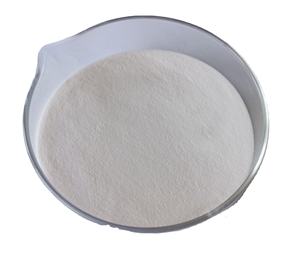
Silicon Carbide Crucibles: The Backbone of High-Temperature Industrial and Artisanal Ceramics
How to Properly Use and Maintain a Silicon Carbide Crucible: A Step-by-Step Guide
7 Essential Facts About Silicon Carbide Crucibles and Their Industrial & Kitchen Uses
How to Properly Use and Maintain a Silicon Carbide Crucible: A Step-by-Step Guide
Why Is Silicon Carbide Crucible Essential in High-Temperature Crystal Growth?